Window of Tolerance: What It Is and How to Widen It

You're not falling apart. Your window got smaller.

There's a zone where you can think clearly, feel what you feel and still choose your response. Burnout shrinks it. Here's how to widen it again.

The window of tolerance is one of the most useful ideas in nervous system work, and one of the most misunderstood. This is the plain-language version, written for capable adults running on empty, not for clinicians.

What is the window of tolerance?

The window of tolerance is the zone where your nervous system can handle what's happening and you can still think, feel and choose how to respond. Go above it and you tip into hyperarousal: fight or flight. Drop below it and you fall into hypoarousal: shutdown. Psychiatrist Dr Dan Siegel coined the term in 1999.

You already know this zone. It's the version of you who can have the hard conversation without your voice shaking, hear tough feedback without spiralling, and sit in a traffic jam without wanting to put a fist through the dashboard. Stress still shows up in there. It doesn't get to drive.

Here's the thing most people miss. Your window isn't fixed. It's wider after a good night's sleep and a quiet week. It's narrower after six months of 60-hour weeks, a sick kid and a restructure at work. Same you. Different window.

The three zones. Where are you right now?

Picture three zones stacked on top of each other. The middle one is your window. The two either side are where your body goes when it decides it can't cope.

01

Above your window: hyperarousal

Too much activation. Racing heart, tight jaw, short fuse, thoughts going a hundred miles an hour. You snap at the people you love, lie awake at 2am replaying a meeting, and can't sit still. In polyvagal terms this is the sympathetic state: fight or flight.

02

Inside your window

Alert, but steady. You feel things fully and you can still think. You can be under pressure and still be present, curious and connected to the people around you. This is ventral vagal, the state of felt safety, and it's the only place real choice lives.

Read Polyvagal Theory, explained
03

Below your window: hypoarousal

Too little. Flat, foggy, numb, disconnected. An hour of scrolling without taking anything in. Knowing exactly what you should do and not being able to start. This is dorsal vagal shutdown, and it often gets mistaken for laziness. It isn't. It's a nervous system that has hit the brakes.

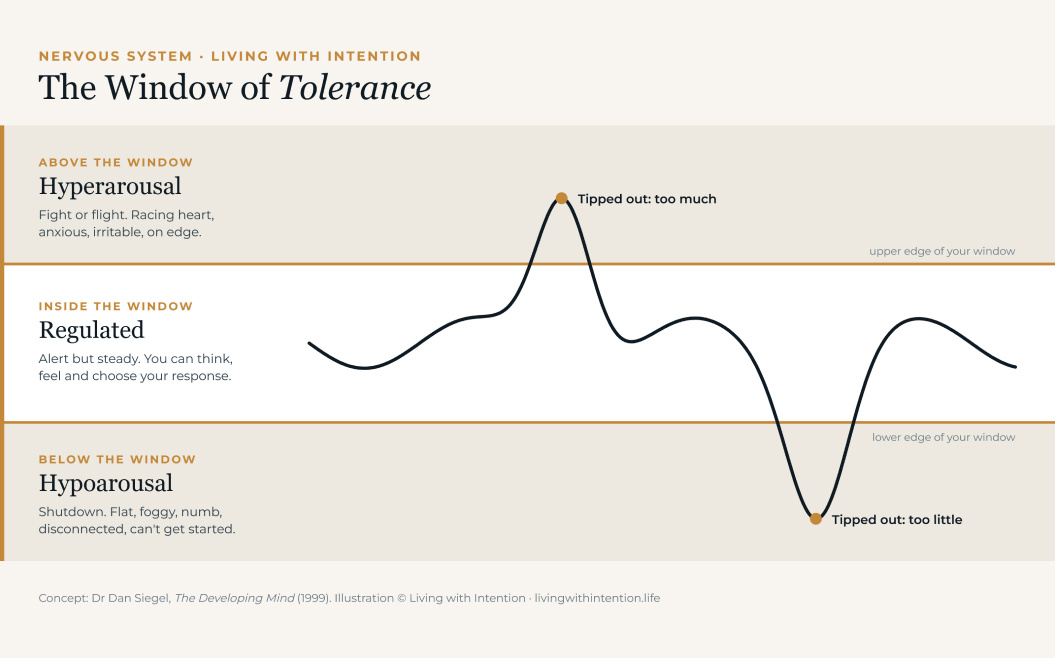
Your window of tolerance, at a glance.

The middle band is your window. The line is you, moving through an ordinary day. Most of the time you ride the ups and downs inside it. Then something tips you over the top edge into hyperarousal, or drops you through the bottom into hypoarousal.

The goal isn't a flat line. Life is meant to move. The goal is a wider window, so the same day doesn't push you out, and when it does, you find your way back in faster.

Get the Window of Tolerance Worksheet

Window of tolerance diagram: hyperarousal above the window, the regulated zone inside it, and hypoarousal below, with a line tipping out of each side

Burnout doesn't mean something's wrong with you. It means your window has shrunk.

Here's what I see over and over with high achievers. You're not weak. You've spent years operating right at the top edge of your window, and calling it drive.

Deadlines, pressure, being the one everyone relies on. For a while that edge feels like your best self. Sharp, fast, switched on. But a nervous system that lives at the edge never gets the signal that it's safe to come back down. So the window narrows. Things that used to roll off you now tip you over. A slow reply from a client. A full inbox on a Monday. Your partner asking an innocent question at the wrong moment.

And when hyperarousal runs long enough, the body pulls the other lever. That's the crash. The whole weekend on the couch. The flatness where ambition used to be. Most people read that as a motivation problem and push harder, which narrows the window even further.

If that's landing a little too close to home, the High Achiever Burnout hub goes deep on why this happens to capable people in particular.

How do you know you've left your window?

Your body tells you before your mind does. Most of us only notice once we're well outside, mid-argument or three hours into the couch. The skill is catching it earlier.

You're probably above your window if your breathing is high and fast, your shoulders are up around your ears, you're interrupting people, everything feels urgent and your patience has gone missing.

You're probably below your window if you feel heavy, numb or far away, your thinking is foggy, people's voices seem to come from a distance and the smallest task feels like climbing a hill.

Neither is a character flaw. Both are your nervous system doing its job: protecting you the best way it knows how. Once you can name which side you've tipped out on, you know which way to steer to get back in.

"You can't think your way back into your window. You have to feel your way back in. The body goes first, then the mind follows. Get that order right and everything else gets easier."

— Andy Fox, Founder, Living with Intention

How to widen your window of tolerance.

You don't widen your window by white-knuckling your way through more stress. You widen it by coming back inside, again and again, until your nervous system trusts that it can. Five practices, in order.

01

Learn your edges

Spend a week noticing the moment you tip out. What happened right before? What did your body do first: jaw, shoulders, stomach, breath? Most people have two or three reliable early warnings. Once you know yours, you can catch the slide at 30% instead of 90%.

Get the Window of Tolerance Worksheet
02

Come back in first

When you're outside your window, don't try to solve the problem. Come back in first. If you're above it, slow your breathing right down, about five seconds in and five seconds out, with your attention on the area around your heart. If you're below it, do the opposite: stand up, move, splash cold water on your face, name five things you can see. Calm down or wake up, depending on which side you fell out.

Listen to the reset meditation
03

Practise when you're calm

Here's the bit everyone skips. The time to train regulation is when you don't need it. A few minutes of heart-focused breathing every morning builds the capacity you'll be drawing on at 4pm on a Thursday. HeartMath has been measuring this effect for more than 30 years.

Get the HeartMath Daily Practice Guide
04

Stretch in small doses

Growth happens at the edge of your window, not outside it. Step towards the thing that stretches you, whether it's the honest conversation, the feedback or the boundary. Notice your body starting to rise, then come back. Edge, back. Edge, back. Each round tells your nervous system it got through, and the window gets a little wider.

05

Protect the basics

Sleep, food, movement, people who feel safe. Not glamorous. But a nervous system running on five hours' sleep and three coffees has a window the width of a letterbox, and no breathing technique will out-breathe that.

Regulation is the floor, not the ceiling.

Getting back inside your window matters. It's the floor. From there you can think clearly, feel what's real and actually choose. But it isn't the ceiling.

Here's why. A lot of what pushes us out of our window isn't the situation. It's the story we bring to it. "I'm not good enough." "If I slow down, it all falls apart." "I'm the one who holds everyone together." Every one of those I Am statements has a body signature: a tight chest, a clenched gut, a jaw that never quite lets go. You can regulate all you like, but if the story underneath stays the same, it keeps dragging you back to the edge.

That's the work the Self Blueprint does. Stage 5, Release, is where nervous system work and identity work meet. You settle the body enough to look at the old story, feel it properly and let it go. Then you design a new one from inside your window, not from the edge of it. All long-lasting change happens at the identity level. Regulation is what gets you there.

Not sure where you're starting from? The free Stage Assessment takes four minutes and shows you which of the eight stages to begin with.

A note on trauma, and when to get more support.

The window of tolerance came out of clinical work, and for many people it's closely tied to trauma. If you have a trauma history, your window may be narrower and the exits more sudden. That makes complete sense. Your nervous system learned to protect you.

What I offer is coaching and education, not therapy or treatment. I'm a HeartMath Certified Trainer & Coach, ACT Coach and IMMA Accredited Mindfulness Trainer. If you regularly experience flashbacks, panic attacks, long stretches of numbness, or feel detached from your body or your surroundings, or if these practices stir up more than they settle, please work with a trauma-informed psychologist or counsellor. Your GP is a good first step.

If you're in crisis, call Lifeline on 13 11 14, any time of day or night, or 000 in an emergency.

Go deeper on your nervous system.

Pick a thread below, or start with the Nervous System Regulation hub for the full picture.

Polyvagal Theory Explained

The three nervous system states behind your window, in plain language.

Read the article →

Nervous System Dysregulation

What it looks like when your body stays stuck outside its window.

Read the article →

Nervous System Reset Techniques

Practical ways to come back inside your window when you've tipped out.

Read the article →

High Achiever Burnout

Why capable people live at the edge of their window, and what recovery actually looks like.

Explore the hub →

Questions people actually ask.

What is the window of tolerance?The window of tolerance is the zone where your nervous system can handle what's happening and you can still think, feel and choose how to respond. Above it is hyperarousal (fight or flight). Below it is hypoarousal (shutdown).

Who came up with the window of tolerance?Psychiatrist Dr Dan Siegel introduced the term in his 1999 book The Developing Mind. It has since become a standard idea in trauma therapy, stress work and coaching. The diagram on this page is our own illustration of his concept.

What is hypoarousal?Hypoarousal is what happens when you drop below your window. You feel flat, foggy, numb or disconnected, and getting started on anything feels impossible. In polyvagal terms it's the dorsal vagal shutdown state. It often gets mistaken for laziness. If it lasts for weeks, talk to your GP.

What is hyperarousal?Hyperarousal is what happens when you go above your window. Your heart races, your thoughts speed up, you feel on edge, irritable or panicky, and sleep gets hard. In polyvagal terms it's the sympathetic fight-or-flight state.

How do I widen my window of tolerance?Learn the early signs that you're tipping out. Come back inside before you try to solve anything. Practise regulation daily while you're calm, step towards stretching situations in small doses, and protect your sleep. The window widens over weeks and months, not overnight.

How does trauma affect the window of tolerance?Trauma can leave the window narrower, so you tip into hyperarousal or hypoarousal faster and with less warning. That's a nervous system that learned to protect you, not a personal failing. If you have a trauma history, work with a trauma-informed therapist alongside any self-practice.

Is the window of tolerance the same as polyvagal theory?No, but the two fit together. Siegel's window describes how much activation you can handle. Porges's polyvagal theory describes the states your body moves through. Above the window lines up with the sympathetic state, inside it with ventral vagal, and below it with dorsal vagal.
Regulation is the floor. Find out what comes next.

Take the free 4-minute Stage Assessment to see where you are across the eight stages of the Self Blueprint, and where to actually start.