Map your three zones
What above, inside and below your window actually feel like for you. Body first, then thoughts.
"Every journey toward an intentional life begins with a single step."
Explore Shop →Know your window. Catch the slide before it catches you.
A free, printable window of tolerance worksheet. Map your zones, spot your early warning signs and track a week of widening your window.
Understanding your window of tolerance is one thing. Knowing what yours actually looks like, on a Tuesday afternoon with a full inbox, is another.
So I made this worksheet to get it out of your head and onto paper. Seven pages. Fifteen minutes to map your window, then a week of noticing. No theory you have to memorise. Print it, fill it in, and keep it somewhere you'll see it.
New to the idea? Start with Window of Tolerance: What It Is and How to Widen It, then come back here to make it personal.
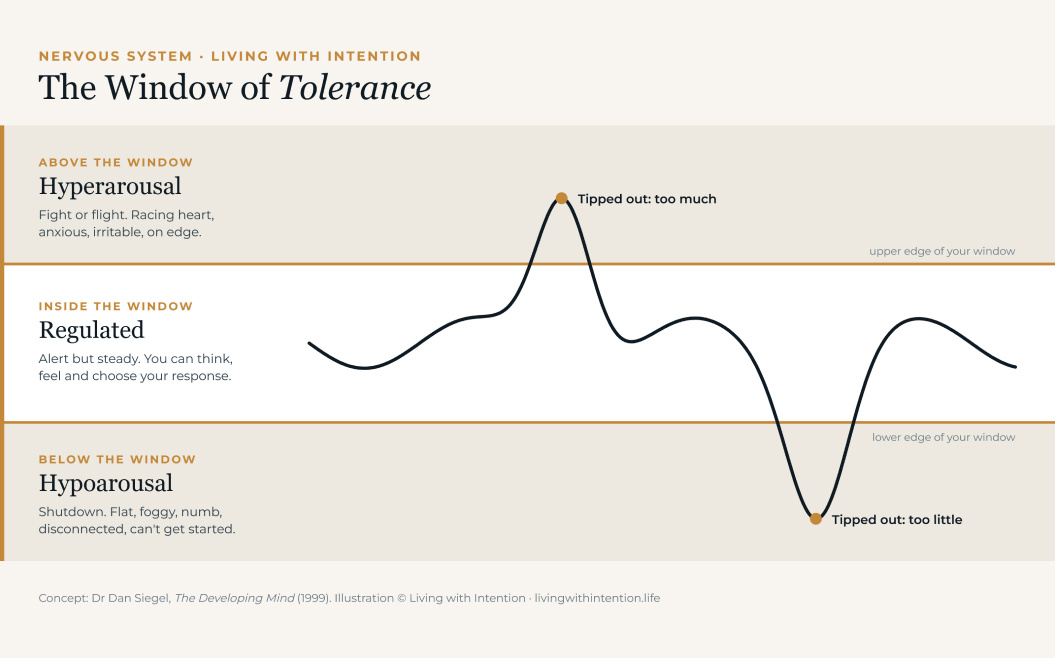
Page two of the worksheet opens with this diagram. The middle band is your window: the zone where you can feel what you feel and still think straight. Above it is hyperarousal, the racing, snappy, fight-or-flight end. Below it is hypoarousal, the flat, foggy shutdown end.
The worksheet helps you fill that diagram in with your own signs, so the next time you start to tip out, you notice at 30% instead of 90%. The concept comes from psychiatrist Dr Dan Siegel. The diagram is our own.
Four parts, done in order. The first two take about fifteen minutes. The last one runs for a week.
What above, inside and below your window actually feel like for you. Body first, then thoughts.
A checklist of the signs you're tipping out, and space to find your first warning and your triggers.
A toolkit for each side of your window: slow down when you're above it, wake up when you're below it.
A daily tracker and a short reflection, so you can see your patterns instead of guessing at them.
I wrote this for capable adults who are running close to the edge: the ones holding everything together and wondering why small things have started tipping them over. If burnout has narrowed your window, this is a practical place to start widening it again.
If you're a teacher, parent or practitioner looking for a window of tolerance handout, you're welcome to use it with the people you work with. It's written for adults, so adapt the language for younger people.
A note on safety: This is coaching and education, not therapy. If you have a trauma history, or you regularly experience flashbacks, panic attacks or long stretches of numbness, please do this work with a trauma-informed psychologist or counsellor. If anything stirs up more than it settles, stop and reach out. In crisis, call Lifeline on 13 11 14, or 000 in an emergency.
Free download. Print it, fill it in, and notice what changes. Regulation is the floor, not the ceiling, and this is a good way to build the floor.
Enter your details and the worksheet will arrive in your inbox straight away.